He made history as Hollywood’s first animal coach. Then he scammed L.A. with ‘iceless ice’
When he told his 19-year-old stenographer that they might both be arrested within quarter-hour, she believed him. She bought in his vehicle and they fled to Yuma, Ariz. There became no motive to doubt him. Paul Bourgeois became "the us's ideal animal trainer," a pioneer cinematographer in the Dutch film industry, the inventor of a brand new "iceless ice," the promoter of los angeles' first full-size skating rink — and her boss.
In Yuma, Joyce Burns received a telegram from her mother, who instructed her to return home: It become simplest Bourgeois who became wanted through police.
Subscribers get early access to this story
We're offering L.A. times subscribers first entry to our choicest journalism. thank you to your aid.
"He admitted he had instructed me i used to be in hazard in order that i would include him," Burns told The instances after she obtained lower back to the metropolis Aug. 22, 1916, just a few days after absconding. "He told me he cherished me and desired to marry me."
however on returning to L.A., Burns all started to learn issues about Bourgeois. He had stolen the motor vehicle and a further woman's heart (as well as her funds). He had stolen greater than that. And he had by no means explained to any person how his iceless ice become going to work.
Bourgeois wasn't even his actual identify: It turned into Paul Sablon.
His accomplishments in European cinema had earned him a spot in early movie heritage, and his Hollywood photos had been hailed within the American press. however from 1916 except his death in 1940, Bourgeois under no circumstances made one other movie, and scholars weren't certain why. Archival data reveal the bizarre purpose: seeking to take competencies of a new fad for ice skating, Bourgeois pretended to invent an ice that wouldn't soften in la, took lots of investors' funds and ran.

Joyce Burns, Paul Bourgeois' stenographer, from The instances, 1916.
(los angeles times)
That the leisure industry attracts greedy opportunists free with the truth will surprise nobody. in exactly the latest illustration, actor Zachary Horwitz closing month agreed to plead responsible to running a massive Ponzi scheme, wheedling greater than $650 million out of traders with made-up movie offers at HBO and Netflix. The little-usual century-old story of Bourgeois now not most effective suggests that it became ever thus but also foregrounds perennial questions that bedevil america (before and after its truth-scammer president). When do benign hucksters turn into malignant frauds? And why do individuals fall under their spell?
Bourgeois and his spouse, actress Rosita Marstini, arrived in Hollywood in summer season 1915 after he made a name for himself as a gifted animal trainer in new york. He had deploy a faculty that informed animals to perform on movie, an innovation that likely brought him to the consideration of Carl Laemmle, who become building a giant studio for regularly occurring images in the San Fernando Valley.
"It changed into a functioning metropolis," says UC Santa Cruz professor Shelley Stamp, writer of "Lois Weber in Early Hollywood." "It had a post workplace and a little medical institution and a fire station. It turned into an amazing location to work."
It additionally had a zoo to residence the stars of the studio's accepted animal shorts. To run this gigantic new commercial enterprise — and market its movies — familiar's chief become in want of ability with a knack for self-promotion.
"Laemmle very generally used the word 'go-getters,'" says Bernard Dick, author of "metropolis of dreams: The Making and Remaking of regularly occurring photos." no one turned into greater of a go-getter than Bourgeois.
"Would you go right into a cage with a tiger?" he reportedly asked probably the most world's most noted opera stars, Ernestine Schumann-Heink, when she visited standard city his first month on the job. She agreed and known as it the superior thrill of her existence — more desirable than singing for composer Gustav Mahler and being made an honorary citizen of 10 international locations. "Am praying for you day by day," she telegrammed Bourgeois after the discuss with. "i am your real and devoted chum."
Success came right away for Bourgeois, who had a ability for donning new hats when opportunities arose. He had begun his career in Europe as a cinematographer for directioné Frères, jumped in entrance of the camera when a production mandatory an actor willing to do a deadly stunt and discovered to coach animals with the help of the nature documentarian who directed his first films. Bourgeois' first picture for popular became a riotous two-reel comedy, "Joe Martin Turns 'Em unfastened." A series of collaborations with Marstini adopted, with Bourgeois credited as actor, author or director and his wife because the celebrity.
"It turned into especially handy within the early days to flow from acting to directing, or screenwriting to directing, or backward and forward," says Stamp. "There changed into a fascinating type of fluidity" that helped husband-and-wife teams thrive. Yet the actress formerly regularly occurring as the "Countess de Marstini� �� (although there isn't any proof of her nobility) in "A Prisoner within the Harem" (1913) became billed in their movies with ease as "Madame Paul Bourgeois." Would it's abnormal if Marstini had had a superior hand in writing or producing these movies than the credit suggest?
"fully not. That's the draw back of husbands and wives working collectively," says Stamp. "After the fact, the men were almost always credited with all the work, or the vast majority of the work, and in many cases, that wasn't real at all."
The media likewise made little note of Marstini's ability at working with the area's most fearsome creatures, preferring to pepper Bourgeois with questions on his trade.
"My system of coaching wild beasts is so simple as ABC," he told a reporter. "Oppression and cruelty will turn any lion right into a demon, whereas firmness, kindness and persistence — limitless endurance — will make him as gentle as a tabby cat."
however Bourgeois wasn't all the time a affected person man. In September 1915, he become charged with animal cruelty, accused of beating a lion to dying, reportedly for not posing accurately right through filming. Two months later, he found himself within the accepted hospital after his hand became beaten by using a undergo. possibly it became then he realized that the career of an animal coach can be a short one. A profile from his time in long island referred to that his hands, neck and back have been already striped with scars.
Yet no inner most correspondence survives that explains why Bourgeois grew to become faraway from filmmaking. Geoffrey Donaldson, a seminal Dutch movie student, as soon as requested Bourgeois' 2d wife about it, however she became unable (or unwilling) to disclose extra, apart from to claim he had "lost activity" in movie, preferring to work in the steel business — go figure. All that's typical is that by spring 1916, a stressed man with a gift for reinvention found himself working as considered one of many filmmakers at a large Hollywood studio, with a acceptance for animal abuse, a history of accidents and, in all probability, a broken marriage.

Rosita Marstini within the film "Blood and Sand" from 1922. She and her husband, Paul Bourgeois, arrived in Hollywood in 1915.
(Paramount pictures / Wikimedia Commons)
On March 2, 1916, the trendy Café Bristol, on the ground flooring of the Hellman constructing at 4th and Spring streets downtown, debuted a brand new attraction for l. a.: a skating rink. Skating became already incredibly common, and cafe rinks were a fad in new york and Chicago. however they were costly. The Bristol's 24-by using-50-foot surface required a $10,000 ammonia refrigeration equipment.
Bourgeois, finger to the wind, sensed a chance. amongst his many ability sets was some potential of chemistry. even though his education record is doubtful, a 1907 doc from a educate crossing the U.S.-Canadian border indicated he worked as an elect rician in Manitoba. He instructed associates that he'd acquired a deferment from carrier within the Belgian army throughout World struggle I since the U.S. Navy become attracted to an alloy of his invention, however no checklist of this exists. In April 1916, he claimed to have invented "iceless ice."
"Mr. Bourgeois claims that this composition can't spoil, except intentionally chopped up, it can't wear out and it can't melt, unless put on a fire," The times stated. "The composition is laid down in liquid form and 'freezes' over, or hardens, in twenty-4 hours."
Bourgeois secured funding to transform a roller rink and automobile dealership at 1041 S. Broadway into the Palace Ice Rink. The grand opening became to be attended in July 1916 by the mayor and feature L.A.'s first game of ice hockey. the entrance became built to resemble a major iceberg. inside had been retail outlets that could sell sweet, ice cream, cigars and soft drinks.
vendors paid Bourgeois hefty deposits to cozy locations in the task. Cashiers could get a job if they paid $100. Dozens of skating instructors lined up to present instructions to wobbly Angelenos. Bourgeois crucial $17 from each of them to buy a uniform.
Contractors, nonetheless busy through the summer time, have been paid basically utterly with exams that bounced. The builders sought out Bourgeois to learn the way his ice turned into imagined to work, however he couldn't be reached. A supplier named Jacques Levi said him to the authorities, and a warrant was issued for Bourgeois' arrest on Aug. 4, wherein time he, his stenographer and his traders' cash have been on their solution to Yuma.
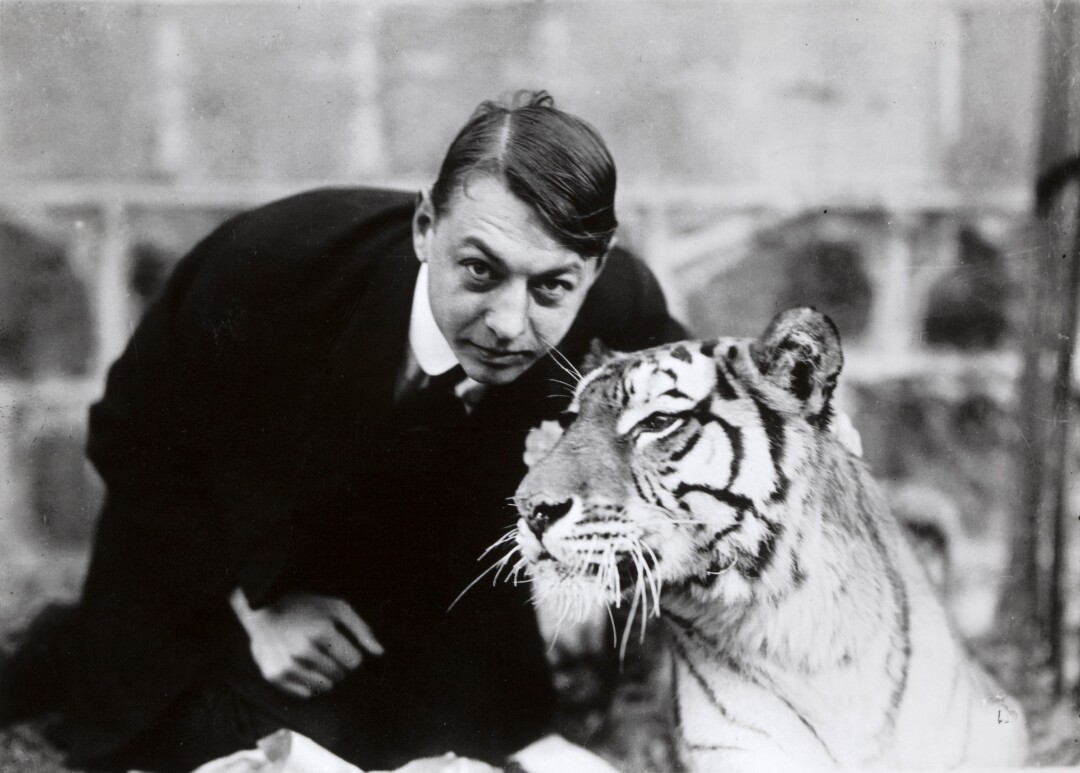
Paul Bourgeois (Sablon) and tiger, undated, from the assortment of EYE Filmmuseum.
(EYE film Instituut Nederland)
the primary time Bourgeois looks on-reveal, within the 1912 Dutch film "Het vervloekte Geld" (The Curse of funds), he's down on his good fortune and arguing along with his lady friend. Tall, lank, his head just a little stooped, Bourgeois may well be wrong for shy, whatever thing stated later through American journalists. was it this boyish method that made him a successful con?
"It's an interesting and famous movie," says Rommy Albers, senior curator with the Eye Filmmuseum in Amsterdam. "Geld" is the story of a grasping businessman who can pay an alcoholic sailor to sink his ship so he can bring together the coverage money.
"There's a lot of films in the Netherlands about fraud with fishermen," says Albers.
So Bourgeois, whose movie career ended with an arrest warrant on suspicion of fraud, received his start playing the victim of 1. His character dies on the ship and returns in a vision that terrifies the guilty sailor.
Bourgeois looks now not to had been haunted through his victims. L.A. authorities found concerning the stolen vehicle, but Bourgeois evaporated. He went overseas and reclaimed his common name. There's some evidence Paul Sablon returned to Chicago and sought citizenship in 1923 — however then the trail goes cold once more. He married a second time in Europe. He told his second wife he'd found work as a tinkerer, first in the U.S. steel industry and then in early tv electronics in England and North Africa. He died of kidney disease in 1940 in Brussels. He turned into fifty one.
Burns, the stenographer, danced in Busby Berkeley films and married some of the accurate cinematographers at Fox. Marstini saved appearing, starring opposite Rudolph Valentino Valentino and eventually acquired a writing credit score for a play that the los angeles Herald described as "coping with the combat between a clever woman, versed within the techniques of the area, and a criminal."
Did Burns and Marstini — or the handfuls Bourgeois become accused of swindling — ever suspect anything else after they regarded into his gray eyes? become it just his appeal that made his lies plausible, or became there greater artwork to it?
in all probability there is a clue in what he once informed a reporter about winning the have confidence of the big cats he trained to perform on movie.
"the entire young trainer asks is to analyze his beast, and to have in mind how most suitable to flatter it."
Johnston has written about background and subculture for Atlas Obscura, Maclean's and the Toronto big name and has taught at Algoma, Stony Brook and Western universities.
Comments
Post a Comment